What to Look For in a Weighted Vest with Removable Weights
A weighted vest with removable weights should be evaluated as training equipment, not simply as a heavier layer. Three details shape how useful it will be: the available load range, the way additional weight is installed, and how evenly the resistance sits on the body. Together, these factors determine whether a vest can support a gradual training plan without interfering with natural movement.
Start with the load range
Look for a starting weight that matches the activity and the wearer's current tolerance, then check whether the vest has enough capacity for future progression. A fixed-weight vest offers one load, which can be appropriate for a narrowly defined workout but may become limiting as the training goal changes. A removable-weight design lets the user begin with less resistance and add weight when the existing load no longer provides the intended challenge. That flexibility is particularly relevant because research has linked weighted-vest exercise with improvements in bone density, leg lean mass, and physical performance in older women (PubMed, study 41752870). Another study reported improvements in lower-body muscular strength of 16 to 33 percent and muscular power of 13 percent in a postmenopausal population using weighted-vest exercise (PubMed, study 9467434).
Those findings do not establish one ideal load for every person. They do show why adjustability matters: the resistance used in a training plan should be selected for the person, movement, and objective rather than locked to a single number. OMORPHO G‑Vest products provide line-specific starting points and progression options. G‑Vest Run starts at 6 lb (2.7 kg) for men and 3 lb (1.4 kg) for women, with G‑Pack panels increasing the maximum to 16 lb (7.3 kg) for men and 9 lb (4.1 kg) for women. G‑Vest Icon starts at 10 lb (4.5 kg) for men and 6 lb (2.7 kg) for women, and can adjust to 20 lb (9.1 kg) and 12 lb (5.4 kg), respectively, with G‑Pack panels (OMORPHO science).
Understand how the removable weights work
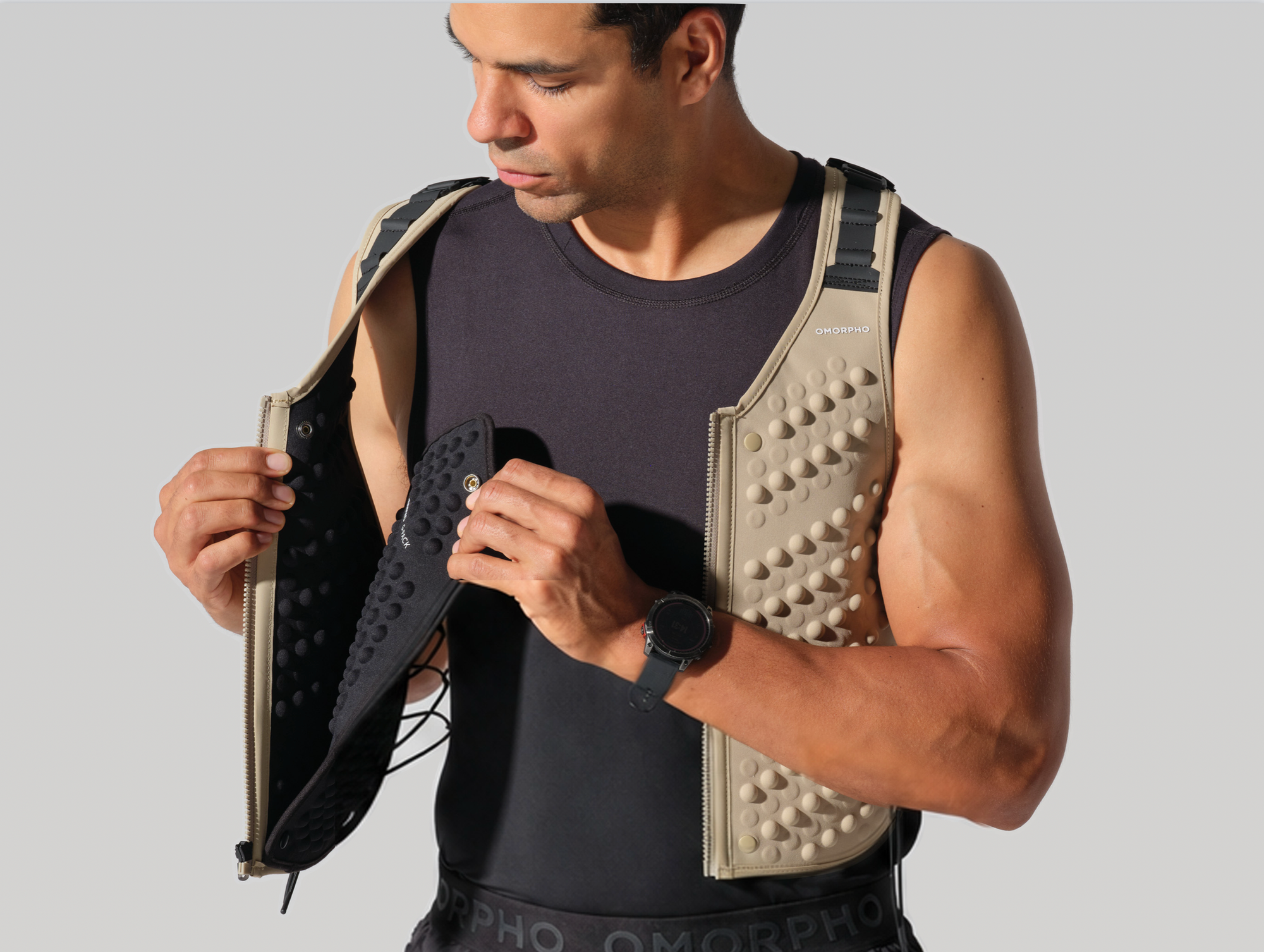
Removable weight is most useful when the adjustment process is secure and repeatable. G‑Pack is a set of three snap-in panels sold separately and designed to work with both G‑Vest Icon and G‑Vest Run. This allows the load to be changed between sessions without replacing the vest itself. Before buying, confirm that the panels are compatible with the specific vest line and gendered fit, and that they stay in place during the intended activity. For a practical explanation of the system, see this guide to weighted vest benefits.
Check where the weight sits
Adjustability cannot compensate for resistance that shifts or concentrates uncomfortably. Look for a vest designed to distribute weight across the body so it moves with the wearer rather than pulling from one isolated point. OMORPHO G‑Vest products use stainless steel ball bearings placed between layers of durable polyester and synthetic fabrics as part of the brand's distributed-weight design (OMORPHO science). A secure, evenly distributed fit helps preserve freedom of movement and makes the selected load more practical for the workout. The best choice is therefore not simply the vest with the most removable weight. It is the vest whose starting load, adjustment system, and fit align with the movements it will support.
Load Range: Starting Weight and Room to Progress
Load range matters because a weighted vest should match the demands of the activity, the starting point of the wearer, and the capacity to progress without forcing a jump that feels too aggressive. General weighted-vest guidance commonly places working loads around 4% to 10% of body weight, but that range should not be applied blindly to every product or workout. The appropriate starting load depends on the vest line, the movement pattern, and how the resistance feels during controlled, repeatable movement. See the research summary from PubMed on weighted-vest exercise and physical performance in older women.
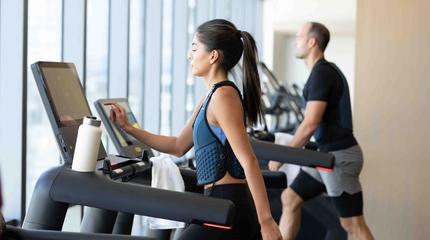
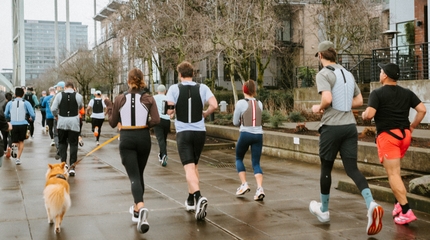
OMORPHO keeps the ranges specific to each G‑Vest category. The G‑Vest Run starts at 6 lb (2.7 kg) for men and 3 lb (1.4 kg) for women. With G‑Pack panels, it can reach up to 16 lb (7.3 kg) for men and 9 lb (4.1 kg) for women. That corresponds to approximately 2% to 8% of body weight, depending on the wearer and configuration. The Run is intended for repetitive, longer-duration activities such as running, jogging, and agility conditioning, where a moderate challenge can be repeated without making the vest the focus of the session. These product specifications and activity recommendations come from OMORPHO product guidance.
The G‑Vest Icon starts at 10 lb (4.5 kg) for men and 6 lb (2.7 kg) for women. Adding G‑Pack panels increases the range to 20 lb (9.1 kg) for men and 12 lb (5.4 kg) for women. The Icon represents approximately 4% to 10% of body weight and is intended for slower movement, power work, high-intensity training, and sessions such as HYROX, rather than jogging or long endurance efforts. Those line-specific ranges and use cases are based on OMORPHO product guidance.
Adjustable resistance also gives a vest more than one useful starting point. A lighter configuration can help a new wearer learn the fit and maintain natural movement. Additional panels can be introduced when the original load no longer provides the intended challenge, provided the activity and technique remain appropriate. This is a progression decision, not a reason to chase the highest available load.
Research supports evaluating weighted resistance by the outcome it helps develop, rather than by load alone. In a study of postmenopausal women, lower-body exercise using a weighted vest improved indices associated with fall risk, including reported gains in lower-body muscular strength of 16% to 33% and muscular power of 13%. Read the findings in PubMed. Another study reported improvements in bone density, leg lean mass, and physical performance in older women following weighted-vest exercise, as described in PubMed. These findings do not establish one universal load for every person. They reinforce the value of choosing a range that can be used consistently, adjusted thoughtfully, and matched to the movement being trained.
How Removable Weights Work: The G‑Pack Panel System
A weighted vest with removable weights gives training more than one fixed setting. The load can be matched to the session, then adjusted as capacity, terrain, or workout demands change. OMORPHO uses the G‑Pack for Vests as the adjustment system for both G‑Vest Icon and G‑Vest Run. The G‑Pack is sold separately and contains three snap-in panels, so the added resistance is integrated into the vest rather than carried as a separate weight. (OMORPHO product specifications)
The practical value is controlled progression. Instead of making a large jump in load, a user can add panels incrementally and pay attention to movement quality, fit, and recovery. That approach keeps the vest useful across different training contexts while preserving the evenly distributed feel of OMORPHO's MicroLoad™ system. (OMORPHO product specifications)
How to add or remove G‑Pack panels
- Choose the vest and starting load. Begin with the G‑Vest that matches the activity. G‑Vest Icon starts at 10 lb (4.5 kg) for men and 6 lb (2.7 kg) for women, while G‑Vest Run starts at 6 lb (2.7 kg) for men and 3 lb (1.4 kg) for women. These line-specific specifications are supplied by OMORPHO. (OMORPHO product specifications)
- Locate the panel positions. The G‑Pack uses three snap-in panels designed for compatibility with both G‑Vest Icon and G‑Vest Run. Confirm that each panel is aligned with its intended position before fastening it. (OMORPHO product specifications)
- Add one panel at a time. Snap in a single panel, secure the vest, and check that it sits close to the body without shifting or restricting the intended movement. Repeat only when the current setting feels controlled. The G‑Pack can add up to 10 lb (4.5 kg) for men and up to 6 lb (2.7 kg) for women. (OMORPHO product specifications)
- Recheck the fit before training. Walk, jog, or rehearse the planned movement at an easy intensity before increasing effort. A secure fit matters because added resistance should remain stable as the body moves. G‑Vest Run is specified for a secure fit without shaking or jiggling, and it accommodates G‑Pack panels. (OMORPHO product specifications)
- Remove panels when the session calls for less load. Release the snap-in panels and store them with the vest. Reducing the load can make sense when changing from a short, intensive session to longer repetitive movement, or when practicing technique. For a detailed walkthrough, see how to adjust vest weight.
With all available G‑Pack loading, G‑Vest Icon adjusts up to 20 lb (9.1 kg) for men and 12 lb (5.4 kg) for women. G‑Vest Run adjusts up to 16 lb (7.3 kg) for men and 9 lb (4.1 kg) for women. (OMORPHO product specifications) Those different ceilings reinforce why the panel system should be evaluated alongside the vest line, not treated as a universal load range.
G‑Vest Icon is intended for slow-movement, power, and intensive workouts, while G‑Vest Run is suited to running, jogging, and other repetitive long-duration sports. (OMORPHO product specifications) In either case, the removable-panel design makes it possible to progress in measured increments while keeping the vest aligned with the work being performed.
Even Weight Distribution: Why the Fit Matters
A vest can offer the right load range and a useful adjustment system, but those features matter less if the weight shifts, pulls, or feels concentrated in one area. Even distribution helps the vest move as part of the body rather than acting like a separate object strapped onto it. That distinction becomes especially important during walking, running, changes of direction, and repeated athletic movement.
OMORPHO uses MicroLoad™ as a method of ergonomically distributing weight around the body. In G‑Vest products, that approach is implemented with stainless steel ball bearings sandwiched between layers of durable polyester and synthetic fabrics. The construction spreads resistance across the vest while helping it stay close to the torso, so the load can move with the body instead of shifting independently. Learn more about the adjustable weighted vest design.
Why concentrated weight can change the experience
Removable weights are valuable because they let users change the challenge. However, adjustability should not mean placing every added panel in one dense area. A concentrated load can make a vest feel less stable and may encourage a person to alter posture or movement to compensate. A close, secure fit supports freedom of movement and makes it easier to maintain the technique appropriate to the activity.
This is not an argument against other vest designs. It is a practical buying criterion: assess how the weight is held, where it sits, and whether the vest remains secure as movement becomes faster or more repetitive. A weighted vest with removable weights should allow the resistance to be adjusted without sacrificing the fit that made the vest comfortable in the first place.
What the research suggests about low-profile loading
Research does not establish that every weighted vest will improve performance, and fit remains specific to the person and activity. One study found that warming up with a weighted vest may improve running performance through changes related to leg stiffness and running economy. The PubMed study on weighted-vest warm-ups supports the value of studying how added load interacts with running mechanics, rather than treating vest weight as the only meaningful specification.
That same principle applies when comparing removable-weight systems. Look for a vest that conforms to the body, keeps the load from shaking or jiggling, and matches the movement the workout requires. G‑Vest products are designed around that natural-movement goal, with evenly distributed MicroLoad™ resistance and a secure fit. For more detail on OMORPHO's wearable-resistance approach, visit the OMORPHO science resources.
Before buying, perform a simple fit check. Fasten the vest snugly without restricting breathing, move through the activity you plan to do, and notice whether the load stays centered. If the vest remains stable while the body bends, rotates, accelerates, and settles, its distribution is working with the workout instead of competing with it.
Which Vest Fits Your Workouts: Icon vs Run
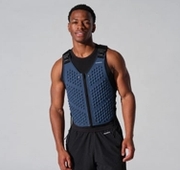
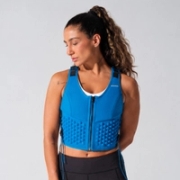
Choosing between OMORPHO's G‑Vest category models starts with the movement the vest needs to support. The G‑Vest Icon is built for higher-load, shorter, or slower sessions. The G‑Vest Run is built for running and other long-duration, repetitive movement. Both use MicroLoad™ distributed weight with stainless steel ball bearings layered between durable polyester and synthetic fabrics, according to OMORPHO's product specifications.
OMORPHO G‑Vest Icon and G‑Vest Run comparison. Weight specifications are from OMORPHO product pages and product specifications.
G‑Vest Icon
- Base Weight (men/women): 10 lb (4.5 kg) men / 6 lb (2.7 kg) women
- Max with G‑Pack: 20 lb (9.1 kg) men / 12 lb (5.4 kg) women
- Best For: Walking, hiking, power work, HIIT, short intensive workouts, and elite training such as HYROX
- Not For: Running
G‑Vest Run
- Base Weight (men/women): 6 lb (2.7 kg) men / 3 lb (1.4 kg) women
- Max with G‑Pack: 16 lb (7.3 kg) men / 9 lb (4.1 kg) women
- Best For: Running, long-duration repetitive movement, and agility conditioning such as soccer or tennis
- Not For: Hiking and walking
The G‑Vest Icon is the more suitable choice when the session allows deliberate, controlled movement and a larger resistance range. Its base weight is 10 lb (4.5 kg) for men's sizing and 6 lb (2.7 kg) for women's sizing. With three additional G‑Pack panels, sold separately, the maximum listed loads are 20 lb (9.1 kg) and 12 lb (5.4 kg), respectively. OMORPHO lists the Icon at approximately 4% to 10% of body weight, depending on the wearer and configuration. These specifications are documented on the men's G‑Vest Icon page and the women's G‑Vest Icon page.
That range suits walking, hiking, power-focused work, HIIT, and short intensive workouts where the goal is to add a meaningful challenge without the repeated impact and stride cycle of a run. It also makes the Icon a practical option for elite training formats such as HYROX. The activity guidance above comes from OMORPHO's product specifications. It is not the recommended choice for running.
The G‑Vest Run starts lower, at 6 lb (2.7 kg) for men's sizing and 3 lb (1.4 kg) for women's sizing. G‑Pack panels can raise the listed maximum to 16 lb (7.3 kg) for men and 9 lb (4.1 kg) for women. OMORPHO lists the Run at approximately 2% to 8% of body weight. That lighter starting point and activity-specific design make it the better fit for running, jogging, long-duration repetitive movement, and agility conditioning for sports such as soccer or tennis. See the men's G‑Vest Run page or women's G‑Vest Run page for the applicable configuration.
A simple rule keeps the choice clear: select G‑Vest Run for running and sustained, repetitive movement; select G‑Vest Icon for walking, hiking, power work, HIIT, and short intensive sessions. The G‑Pack system is compatible with both G‑Vest models, so removable weight can support progression within the model that matches the workout rather than turning one vest into a compromise for every activity.
Care and Longevity of Your Removable Weight Vest
A weighted vest with removable weights can stay ready for regular training when its materials are cleaned according to the manufacturer's care instructions. For OMORPHO G‑Vest products, that means treating both the vest and its G‑Pack panels as hand-clean items, not as machine laundry. The product care guidance in the OMORPHO customer knowledge base states that G‑Vest and G‑Pack products are not machine-washable because their resistance comes from stainless steel ball bearings enclosed between layers of durable polyester and synthetic fabrics.
After a workout, rinse the vest or wipe it by hand with water. Use a clean cloth to remove sweat or surface residue, paying attention to areas that contact the body. Avoid putting the vest or G‑Pack panels in a washing machine. Once cleaning is complete, hang the pieces to dry. The same OMORPHO care guidance recommends hand rinsing or wiping and hang drying for these products. Following that process helps keep the laminated fabric construction and removable panels in use without exposing them to a wash cycle they are not designed to withstand.
Store the vest and panels as a complete system
When the G‑Pack panels are not needed, remove them before cleaning and store them with the compatible vest. The G‑Pack is a set of three snap-in panels designed for use with G‑Vest Icon and G‑Vest Run products, according to the OMORPHO customer knowledge base. Keeping the panels together makes it easier to select the intended resistance for the next session and reduces the chance of misplacing an individual panel.
Inspect the vest, closures, and panel attachment points before training. If a component appears damaged or does not secure as intended, pause use and contact OMORPHO for product guidance rather than continuing with an unstable setup. This is practical equipment care, not a substitute for the manufacturer's current instructions.
Care differs for G‑Wear apparel
G‑Wear apparel follows a different cleaning routine. OMORPHO's customer knowledge base identifies G‑Wear as machine-washable and dryable. That distinction matters when building a rotation of wearable resistance: wash G‑Wear according to its product instructions, while keeping G‑Vest products and G‑Pack panels out of the machine. Using the right care method for each product helps preserve the function and fit of the gear across repeated training sessions.
Browse the OMORPHO weighted vest collection to see which vest and G‑Pack panels fit your training goals.
Frequently Asked Questions
Is there a weighted vest with adjustable weights?
Yes. Look for a vest with a secure adjustment system, not simply a larger fixed load. OMORPHO G‑Vest Icon and G‑Vest Run accept G‑Pack, a set of three removable snap-in panels sold separately and compatible with both vest lines, according to OMORPHO product specifications. This lets the wearer add resistance as the training goal changes while keeping the vest fitted to the torso.
How heavy should a removable-weight vest be?
Start with the lightest load that lets the wearer maintain controlled, natural movement, then progress gradually. The appropriate range depends on the vest line and activity. OMORPHO specifies G‑Vest Run at 2-8% of body weight and G‑Vest Icon at 4-10%, with the exact base and maximum loads varying by men's and women's models. See OMORPHO product specifications for the current product-specific figures.
Are weighted vests safe for running?
A vest can be appropriate for running when the load, fit, and progression match the runner's experience, but not every vest is designed for that use. OMORPHO positions G‑Vest Run for running and other repetitive, long-duration sports, while G‑Vest Icon is intended for walking, hiking, power workouts, and HIIT rather than running, according to OMORPHO product specifications. A study indexed by PubMed also examined weighted-vest warm-ups in relation to running performance: PubMed, 2014.
What is the benefit of removable weights in a vest?
Removable weights make one vest more adaptable to different sessions, fitness levels, and progression stages. They can also help a wearer choose a moderate starting load instead of committing to the vest's full capacity. Adjustability is most useful when the panels stay secure and the vest continues to distribute resistance evenly rather than shifting during movement.
Can you wash a weighted vest with removable weights?
Check the care instructions before cleaning. OMORPHO G‑Vests and G‑Pack panels are not machine-washable because they contain ball bearings in laminated fabric. OMORPHO product specifications recommend rinsing or wiping them by hand and hanging them to dry. G‑Wear apparel has separate care guidance and is machine-washable and dryable.
Ready to Find Your OMORPHO Weighted Vest?
The right vest depends on how you train, the load you want to start with, and how much room you want to progress. Explore the OMORPHO collection to compare available G‑Vest options and choose a fit that supports your workouts. Shop the OMORPHO weighted vest collection to find the right load range and fit.