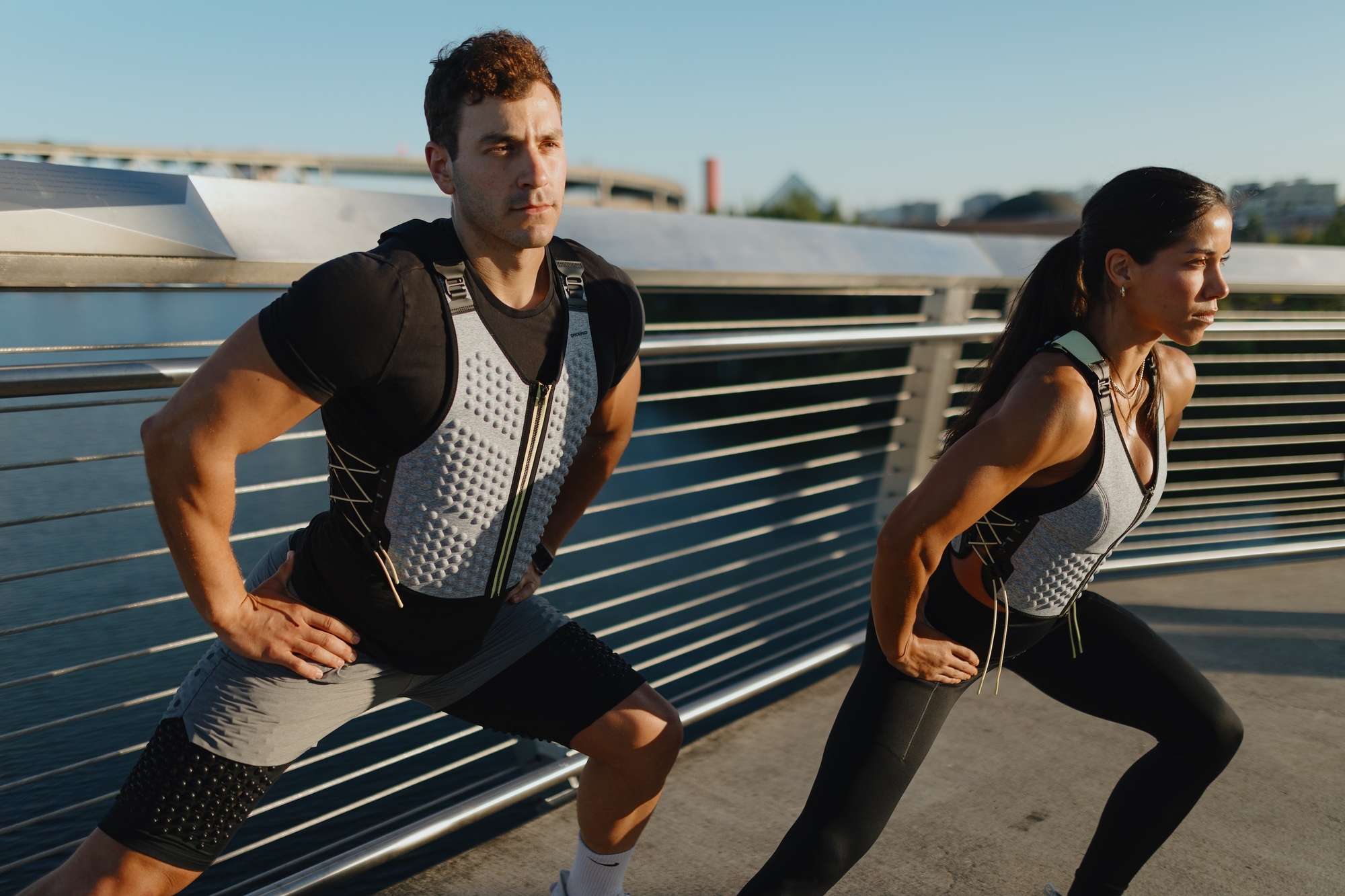
Why Cross-Train with a Weighted Vest
Cross-training combines different types of exercise, usually blending strength work, cardiovascular conditioning, mobility, and movement skills instead of repeating one training pattern every session. A circuit might move from a squat or push-up to a short conditioning interval, then into a mobility drill or core exercise. The variety keeps training adaptable while asking the body to produce force, control movement, and recover repeatedly.
A weighted vest adds external resistance without requiring dumbbells, a barbell, or a machine. That makes it useful for bodyweight movements and circuits where the hands need to stay free. The added load increases the intensity of familiar exercises, so a lunge, step-up, push-up, or bodyweight conditioning drill becomes a more demanding version of the same movement. The goal is not to change the movement pattern. It is to make the body manage more resistance while maintaining sound technique and range of motion.
One session can challenge strength and endurance
Resistance-loaded circuits create an overlap between muscular strength and cardio endurance. Muscles must keep producing force as the heart and lungs respond to a continuous sequence of exercises. That combination is especially relevant to athletes who need to repeat powerful movements without losing posture, control, or coordination. A vest can also make the body stabilize against the added load, bringing more attention to core stability and posture control during transitions.
The resistance should support movement rather than compete with it. Around 4-6% of body weight is used as a practical range for a measurable challenge without impairing movement, according to OMORPHO product guidance. The right load still allows the wearer to breathe, change direction, and complete each exercise with control. If the vest alters technique or makes a circuit feel like a test of simply carrying weight, the load is too high for that session.
Progress the workout without rebuilding it
A vest also gives a familiar program a clear progression. Once a bodyweight circuit no longer provides the same challenge, adding wearable resistance can increase demand while preserving the exercise sequence. This approach supports progressive overload, allowing the body to continue adapting as training capacity develops. Start with movements that are already technically consistent, then adjust the load or work interval gradually rather than adding resistance to every exercise at once.
For a secure, evenly distributed option that stays close to the body through multi-planar circuits, explore the G‑Vest collection.
How the G‑Vest Icon Works for Strength and Power
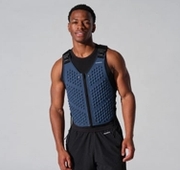
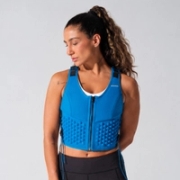
The G‑Vest Icon is built for workouts where resistance needs to stay connected to the body as movement gets faster, more complex, or more explosive. It is designed for power workouts, high-intensity intervals, and short, demanding sessions rather than running or long-duration endurance work.
Its MicroLoad™ design distributes resistance across the core through stainless steel ball bearings housed between layers of durable polyester and synthetic fabrics. Instead of placing a concentrated load in one rigid area, the construction conforms to the body and supports a more natural movement pattern. That matters when a session moves between jumps, presses, crawls, squats, and other multi-planar exercises.
Stable resistance for complex movement
A weighted vest is only useful for power training if it stays where it belongs. The G‑Vest Icon is designed for a secure fit without shaking or jiggling, helping the wearer maintain control through changes in direction and body position. Consistent resistance lets the athlete focus on producing force, absorbing force, and maintaining alignment instead of adjusting a shifting vest between repetitions.
That stability also gives the trunk a continual demand for posture control. As the vest adds external resistance to bodyweight movements, the body must stabilize against the load while the limbs move freely. The result is a training stimulus that can complement strength, balance, and power-focused circuits without restricting a full range of motion.
Adjustable loading for progressive challenge
The G‑Vest Icon starts at 10 pounds for men and 6 pounds for women. G‑Pack snap-in panels allow the load to increase as training demands change, with the Icon adjustable up to 20 pounds for men and 12 pounds for women. Adjusting resistance makes it possible to keep the movement quality high while progressing the challenge gradually.
Adding load increases the intensity of muscular effort. Research on loaded exercise protocols identifies that higher muscular effort as an important part of long-term power adaptation. For a closer look at the principles behind wearable resistance, explore the science of wearable resistance.
Use the Icon when the goal is a more demanding, controlled challenge during short intensive work. It is not the right choice for jogging or running, where lighter resistance and uninterrupted stride efficiency take priority.
What Is a Good Weighted Vest Cross-Training Circuit?
This short circuit is designed for power, control, and full-body coordination rather than mindless fatigue. Wear a G‑Vest Icon and move through each station with clean mechanics. The added resistance should make the body stabilize against shifting loads, reinforcing core stability and posture control while preserving a full range of motion.
Choose a manageable starting load. The G‑Vest Icon provides roughly 4-10% of body weight, but the right place to begin depends on training experience, exercise selection, and movement quality. Start lighter, then progress only when every repetition remains controlled. Complete two to four rounds, resting 60-90 seconds between rounds. Rest 20-40 seconds between stations, or take longer when breathing or technique starts to deteriorate.
- Bodyweight squat, 10-12 repetitions. Stand with feet about shoulder-width apart, brace the trunk, and lower under control. Keep the chest tall and let the knees track in line with the toes. Drive through the floor to stand without rushing the final lockout. The vest adds resistance while the squat trains lower-body strength and posture under load.
- Push-up, 6-12 repetitions. Set the hands beneath or just outside the shoulders and create one stable line from head to heel. Lower the chest through a comfortable range of motion, then press up while keeping the ribs from flaring. Use an elevated surface if the vest causes the hips to sag or shortens the movement.
- Reverse lunge, 8 repetitions per side. Step back quietly, lower until both knees are comfortably bent, and keep the front foot planted. Return to standing by driving through the front leg. Alternate sides, maintaining a level pelvis and controlled torso through the transition.
- Box jump, 5-8 repetitions. Use a low, stable box and prioritize a quiet landing over height. Hinge, swing the arms, and jump with a deliberate effort. Land softly with knees aligned, stand fully, and step down. Stop the station if landing mechanics become heavy or inconsistent. The vest should allow the explosive movement and full range of motion, not restrict either.
- Forearm plank, 20-30 seconds. Place the elbows below the shoulders, squeeze the glutes, and brace as if preparing for contact. Keep the head, ribs, and hips aligned. Do not let the lower back arch as fatigue builds. This station reinforces trunk control after the dynamic movements.
- Burpee, 5-8 repetitions. Lower into a squat, place the hands, step or jump the feet back, and return to a balanced stance before standing tall. Add the jump only if control remains consistent. Keep the effort short and intensive, then use the assigned rest before beginning the next round.
Progress by adding a round, improving range of motion, or increasing repetitions within the listed range before adding load. That approach keeps the circuit focused on power, stability, and repeatable movement quality.
How Do Bodyweight Progressions Hit Harder with a Vest?
Bodyweight training can keep progressing when the movement stays familiar but the demand increases. A weighted vest adds external resistance to patterns such as pushing, pulling, squatting, and pressing, giving each repetition more work without requiring a completely different exercise. The goal is not to rush into the heaviest load. It is to preserve control, depth, and full range of motion while gradually increasing the challenge.
Push, pull, and squat patterns
Start with movements that already have a reliable technique. Push-ups become a loaded horizontal press, while pull-ups add resistance to a vertical pull. Squats, split squats, and step-ups place the added demand into lower-body patterns that transfer well to broader cross-training sessions. With each exercise, keep the same standards used without load: a controlled descent, stable alignment, and a complete range of motion.
For explosive work, that standard matters even more. Weighted-vest training is designed to support full range of motion during movements such as pull-ups, push-ups, and box jumps. A vest should not force a shortened push-up, disrupt the path of a pull-up, or make a box jump feel unstable. If the added resistance changes the movement quality, reduce the load or return to an unweighted variation.
Use progressive overload without changing the whole workout
Progressive overload does not require turning every session into a test of maximum effort. Once a bodyweight movement is consistent, adding a manageable amount of resistance can create a new training demand while keeping the exercise recognizable. Over time, the same progression can move from controlled repetitions to faster, more powerful execution, provided posture and range remain intact. This approach helps the body continue adapting to exercise demands and supports power and strength adaptation rather than a narrow focus on muscle growth.
G‑Vest Icon is intended for power workouts, short intensive sessions, and high-intensity training. It can upgrade a familiar circuit of push-ups, pull-ups. Squats and box jumps by adding resistance across the torso instead of requiring a plate, dumbbell, or barbell for every pattern. That makes it useful when the session needs to stay fast, athletic, and built around natural movement.
Let the vest support the movement
G‑Vest products use MicroLoad™ distributed through stainless steel ball bearings held between durable fabric layers. The ball bearings conform to the body, helping the vest maintain a low-profile fit as the torso changes position. For cross-training, that fit is practical: resistance stays close to the body while the athlete moves through multiple planes, transitions between exercises, and lands from explosive work. The vest should feel secure rather than distracting, allowing technique to lead the progression.
Choose a variation that can be completed with consistent control, then increase the challenge only when full range of motion and clean alignment remain available. That is how a vest becomes a useful progression tool instead of a shortcut to sloppy repetitions.
How Does G‑Wear Layer in Everyday Micro-Challenges?
The G‑Vest Icon is built for power work, intensive circuits, and short sessions where a consistent load helps make each movement more demanding. G‑Wear extends that approach into the rest of a training day. The apparel adds a smaller, distributed challenge during warm-ups, conditioning blocks, mobility work, and recovery movement without turning every session into a maximal effort.
Use the vest for intensity, then keep moving
Pairing the G‑Vest Icon with G‑Wear creates two distinct layers of resistance. The vest can support high-intensity work such as loaded squats, carries, presses, and explosive bodyweight movements. A G‑Top Short Sleeve, G‑Top Long Sleeve, G‑Tank, or G‑Tight can then add subtle resistance during lower-intensity movement, technical drills, or longer conditioning segments.
That distinction matters in cross-training. The G‑Vest Icon is suited to focused power and intensive work, while G‑Wear supports a micro-challenge that can be repeated across more everyday movement. It gives training sessions more range instead of relying on one load for every purpose.
Small resistance, repeated with control
G‑Wear uses a high-density polymer print fused to the fabric. The construction is durable, machine washable, and dryable, making it practical for frequent use. Because the resistance is integrated into the garment, the apparel stays close to the body as movement changes direction. That can help keep attention on footwork, posture, coordination, and technique rather than on managing loose equipment.
Repetitive resistance-loaded movement can support improvements in agility and reaction time when it is paired with purposeful drills and consistent practice. Use G‑Wear for lateral movement, controlled steps, dynamic warm-ups, and recovery circuits where the goal is to keep moving well under a manageable challenge. The result is not about forcing maximum effort into every minute. It is about building more opportunities to practice efficient movement.
Explore G‑Wear options to build a layered approach: the G‑Vest Icon for power and intensive work, then G‑Wear apparel for repeatable micro-challenges that carry into conditioning and everyday movement.
Pair your G‑Vest Icon with G‑Wear to layer resistance across every part of your training day.
Frequently Asked Questions
Is it good to train with a weighted vest?
It can be useful for cross-training when the added resistance complements the movement and does not disrupt technique. A vest increases the intensity of bodyweight exercises, while a secure, evenly distributed fit helps maintain natural movement through circuits that include multiple planes and transitions.
How heavy should a weighted vest be for cross-training?
Load should match the exercise, training experience, and ability to keep clean form. OMORPHO guidance places wearable resistance around 4-6% of body weight for a measurable challenge without impairing movement. The G‑Vest Icon starts at 10 pounds for men and 6 pounds for women, with additional loading available through G‑Pack panels.
Is a 20-pound weighted vest too heavy?
Not automatically, but it may be excessive for a particular athlete, exercise, or circuit. Heavier loading can change mechanics and accelerate fatigue, especially during explosive or multi-planar work. Begin with a load that allows consistent range of motion, stable posture, and controlled landings, then progress only when those qualities remain intact.
What is the rule for using a weighted vest in circuits?
Use the vest to reinforce quality movement, not to force every exercise to failure. Select a load that stays secure without shaking or jiggling, keep the full range of motion, and reduce the load when technique breaks down. The G‑Vest Icon is intended for power, HIIT, and short intensive workouts, rather than running.
Ready to Shop the G‑Vest Icon Collection?
A well-designed weighted vest can make familiar full-body circuits more demanding while keeping the focus on controlled movement, stability, and power. The G‑Vest Icon is built for short, intensive workouts and progressive training. Shop the G‑Vest Icon collection to choose the option that fits your training approach and start building more intentional resistance into your cross-training sessions.