Why Runners Over 40 Start Running with Weights
When age increases, athletes must adjust how they train to maintain their pace and stay healthy. Many runners over 40 focus solely on logging more miles. But adding weights to a training plan is crucial for longevity. Starting a smart routine that combines cardio with resistance helps protect the body against natural, age-related changes. This is why running over 40 with weights is growing in popularity among mature athletes.
The impact of sarcopenia on stride power
As the body ages, a process called sarcopenia begins. This is the natural loss of muscle mass and strength. This loss starts after age 40 and reduces stride power, which can slow your pace. To counter this decline, experts suggest that older runners do regular resistance work. Training with weights two to three times per week can help keep your muscles strong and maintain your speed. Regular strength training positively affects muscle mass and physical function in active older adults.
Protecting bone health as injury risks rise
Bone density also starts to drop after age 40, which raises the chance of getting hurt. This drop is a major concern for women who are close to menopause. Lower bone mass increases the risk of stress fractures and other running injuries. Putting a safe load on the skeleton helps keep bones strong. A study of aging runners found that maintaining training volume and pace may help maintain ankle plantarflexor kinetics. That study did not examine weighted vests, bone health, or joint impact (Paquette et al., 2018, PubMed 29016393). When you introduce weighted resistance into a running program, progress gradually and monitor how your body responds.
Preserving running economy with age
While some physical traits change, other aspects of your fitness remain strong as you age. Research shows that runners older than 65 years retain a youthful running economy despite having lower leg stiffness than younger athletes. This means your body can still use oxygen and energy well. Biomechanical changes do occur, but they do not have to ruin your performance. Adding light, distributed resistance helps you preserve this natural economy. Using these tools can help you explore the running benefits of MicroLoad™ weighted gear while keeping the focus on a natural stride. This approach makes training with weights a smart choice for long-term health.
How Wearable Resistance Supports Muscle, Bone, and Running Economy
As the body ages, keeping muscle mass and bone health becomes a major goal for runners. Wearable resistance is a proven tool to meet these needs. By using low-load weights distributed across the body, runners can add a gentle challenge to their stride. This approach helps active adults stay healthy without putting extra stress on their joints.
Combating age-related muscle loss
Aging leads to a natural decline in muscle mass and physical function, a process known as sarcopenia. Research shows that regular resistance training can help counter this loss of muscle and strength (PubMed Central PMC11514607). For older runners, keeping muscle strength is key to keeping power in each stride. Adding light resistance to a training routine helps keep muscles active and strong.
Wearable resistance makes it easy to add strength work to your weekly runs. This style of training helps active runners run longer and keep muscle without lifting heavy gym weights. Those who want to learn more can read about the running benefits of MicroLoad™ weighted gear to see how it builds fitness over time.
Supporting bone density safely
Bone density drops as people grow older, raising the risk of stress fractures and other injuries. Putting a load on the bones is needed to trigger bone growth. Studies show that long-term weighted-vest training helps prevent bone loss in the hips (PubMed 10995045). For active runners, this means that adding weight is a proven path to stronger bones.
When running over 40 with weights, many runners look for a system that spreads the weight evenly. OMORPHO products place low-load weights across the body. This design is intended to keep the load close to the body and support natural movement, but product design alone does not establish a bone-health or joint-impact outcome.
Improving running economy
Running economy is a measure of how much energy a runner uses to run at a set speed. A study of aging runners found that training pace may influence ankle plantarflexor kinetics, but it did not test wearable resistance or running economy (Paquette et al., 2018, PubMed 29016393). Wearing light weights during training adds a challenge, so progression should be gradual and guided by form and recovery.
By using science-backed design, OMORPHO gear helps runners build strength while keeping their natural running stride. It is an ideal way to boost training results without changing your form. To read the research behind these fitness tools, you can explore the science of wearable resistance on the main website.
The Best OMORPHO Gear for Running Over 40
Choosing the right gear is key when running over 40 with weights. Standard ankle weights or heavy packs can strain your joints and alter your stride. OMORPHO solves this problem by spreading small amounts of weight across your body. This allows you to explore the running benefits of MicroLoad™ weighted gear while keeping the focus on gradual progression and form.
The G‑Vest Run for Balanced Loading
For running, choose the G‑Vest Run. Do not use the G‑Vest Icon for running, as that heavier vest is meant for slow movement and strength work.
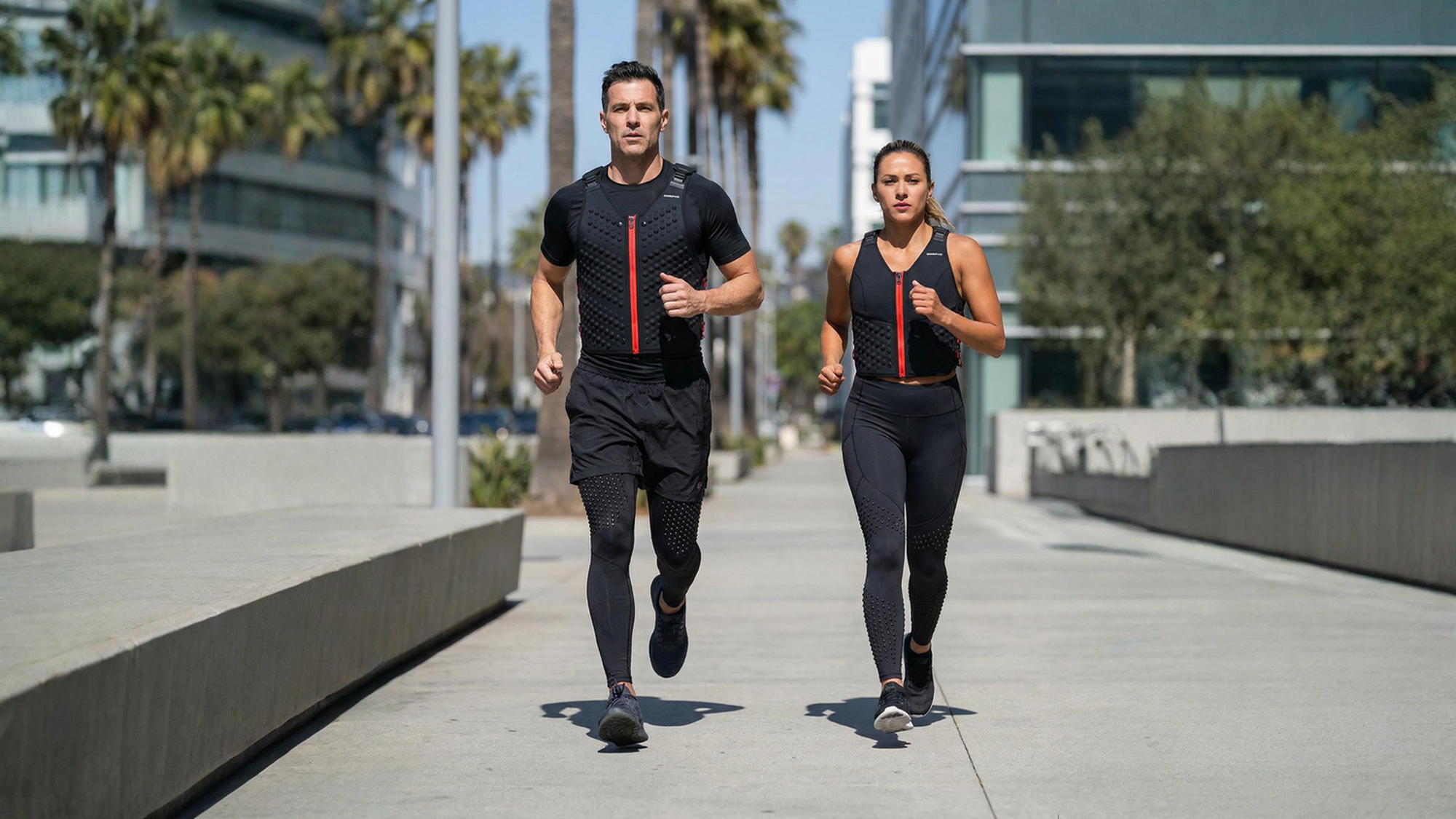
The G‑Vest Run weighs 6 lb (2.7 kg) for men and 3 lb (1.4 kg) for women. This weight is placed close to your center of mass, which keeps the vest secure. It does not shake or jiggle as you jog. The G‑Vest Run can represent approximately 2-8% of body weight, depending on the runner and the selected size. This line-specific range describes the product's adjustable load, not a guarantee about safety or performance. Paquette et al. studied training volume and pace in aging runners, not weighted vests or bone health (PubMed 29016393). If you want to increase the load, you can buy snap-in G‑Pack panels. These panels can raise the vest weight up to 9 lb (4.1 kg) for women or 16 lb (7.3 kg) for men.
Weighted G‑Wear for Extended Distance
While the vest loads your core, G‑Wear apparel places weights on your arms and legs. G‑Wear is designed to add a small challenge during repetitive movement. The appropriate load depends on the specific garment and wearer, so use the product specifications and begin conservatively. The small weights are made of high-density polymer print fused to the fabric. This design creates a small challenge that builds up over thousands of strides during long runs. You can wear pieces like the G‑Tight or G‑Short 2-in-1 during warm days. These items are durable, machine washable, and safe to tumble dry. You can find these pieces in the gravity wear collection. They fit snugly to prevent chafing while you move.
Layering for Distributed Resistance
You do not have to choose between a vest and weighted apparel. In fact, layering your gear is a great way to combine distributed resistance. When you wear both a G‑Vest Run and G‑Wear, you spread the weight across your whole body. This prevents the weight from being focused in just one spot, which keeps your natural movement intact. To start, you can view the gravity vests collection to find the right G‑Vest Run configuration. Then, you can read about adding weighted resistance into a running program to plan your weeks. Layering your gear helps you in several ways:
- It spreads the load across the body.
- It offers a way to adjust the resistance as fitness changes.
- It keeps progression separate from any single loaded run.
A Sample Weekly Running Plan with Distributed Resistance
Starting to run with weights can help you stay strong and active. Starting running over 40 with weights requires a clear plan to protect your joints. A smart program blends gradual running resistance with needed recovery and strength work.
Planning the Training Week
To run safely after forty, you should keep the extra load light. MicroLoad™ G‑Wear gear is intended to provide a small challenge over repeated strides. For a more substantial running load, the G‑Vest Run is the running-specific vest option. Its product range is approximately 2-8% of body weight, depending on the runner and selected configuration. Start conservatively and reduce or remove the load if it changes form or causes discomfort.
Adding weight to your body helps maintain muscle and bone health. Paquette et al. examined training volume, pace, and lower-limb kinetics in aging runners, not wearable resistance or joint impact (PubMed 29016393). Runners can also explore structured MicroLoad™ running plans that detail this approach.
Weekly Resistance Plan
This simple schedule shows how to combine easy runs, fast sessions, and rest. Follow these six steps to start your weekly routine:
- Day 1: Easy Run with G‑Wear. Run for twenty to thirty minutes at a slow pace. Wear a weighted shirt or tights to add a mild challenge to your normal stride.
- Day 2: Recovery and Rest. Take a full rest day or do light stretching. Rest is vital to let your muscles heal and adapt after carrying extra weight.
- Day 3: Tempo and Strides with G‑Vest Run. Warm up, then perform a short tempo run. Wear a G‑Vest Run to boost your core stability. This vest weighs 3 lbs (1.4 kg) for women or 6 lbs (2.7 kg) for men.
- Day 4: Active Rest. Do a short, slow jog or walk with no extra weight. Keeping some days light ensures you do not strain your joints.
- Day 5: Progression Run with G‑Pack. Perform a progressive run where you speed up near the end. As you progress, snap in G‑Pack panels. They can raise the total vest weight. Women can load up to 9 lbs (4.1 kg), while men can add up to 16 lbs (7.3 kg).
- Day 6: Long Run with G‑Wear. Complete your weekly long run wearing G‑Wear gear. The subtle weight will help build endurance over the course of your longer miles.
Weekly Strength Sessions
You should also include two to three strength training sessions each week. Experts suggest that steady resistance work is key to keeping your muscles active as you age. A study in PMC11514607 shows that resistance training helps preserve muscle mass and physical function. Mixing strength work with weighted runs will help you build stamina and speed.
Recovery, Progression, and Staying Injury-Free as a Master Runner
Running over 40 with weights needs a smart path to avoid injury. Master runners should start light with G‑Wear apparel, which is designed to provide a subtle challenge across repeated strides. Each runner should monitor form and recovery. To build a safe habit, master runners should follow a plan for adding weighted resistance into a running program. This gradual start allows muscles and tendons to adapt to the new workload.
After the body adapts, runners can add a G‑Vest Run to their routine. Layering a G‑Vest Run and G‑Wear apparel spreads weight across the body instead of pooling load in one spot. This even load keeps the stride natural and protects the joints. It also makes sure that no single muscle group takes on too much strain during runs, which keeps movement fluid.
Smart loading progression
Runners over 40 should balance training stimulus with recovery. The Paquette et al. study found that training pace may influence ankle plantarflexor kinetics in aging runners, but it did not examine wearable resistance, bone health, or joint impact (PubMed 29016393). Use that distinction when evaluating claims about loaded running.
The need for rest
Recovery plays a major role in any training plan. Muscles and joints need time to repair after a run. Master runners should space out their loaded runs, leaving at least one day of rest between them. Listening to the body is key. If a joint feels sore, it is best to rest or switch to a light walk. This simple step helps keep training on track and prevents long term wear and tear. Rest days are just as vital as active days for long-term health.
Gear care and hygiene
Keeping weighted gear clean is also part of a good routine. OMORPHO G‑Wear apparel uses a high-density polymer print fused to the fabric to add light weight. This G‑Wear apparel is machine-washable and dryable, making it simple to wash after a hard run. It dries fast, so it is ready for the next workout. Washing often keeps the fabric fresh and smelling clean.
On the other hand, G‑Vest products and G‑Pack snap-in panels require different care. These items are not machine-washable. A runner should rinse or wipe them by hand and hang them to dry. This protects the fabric and internal weights from damage. Proper care keeps the gear in top shape for years.
Explore the gravity vests collection to find your G‑Vest Run today
Frequently Asked Questions
Is it safe to start running over 40 with weights?
Yes, it is safe if you use well-distributed resistance that does not alter your natural movement. Unlike heavy weights that strain your joints, the G‑Vest Run is designed for approximately 2-8% of body weight, depending on the runner and selected configuration. Start with a conservative load and stop if form changes or discomfort develops. You should start slow and build up your road time.
Does running over 40 with weights help improve bone density?
Yes, adding weight while you run helps keep your bones strong as you age. Research shows that weight-bearing training can help prevent bone loss. According to a study published on PubMed, regular exercise with a weighted vest helps prevent hip bone loss in older adults. Wearable resistance is a simple way to add this helpful stress to your bones.
How much weight is recommended for running over 40 with weights?
Keep the added load conservative while running. The G‑Vest Run product range is approximately 2-8% of body weight, depending on the runner and selected configuration, but that range is not a universal starting prescription. G‑Vest Run provides 6 lbs (2.7 kg) of resistance for men and 3 lbs (1.4 kg) for women. This low weight is intended to support a stable, natural-feeling fit, but no product can guarantee a particular joint or stride outcome.
Does running over 40 with weights increase the risk of injury?
Injury risk depends on the individual, the load, the running surface, training history, and progression. OMORPHO G‑Vest Run is designed to place evenly distributed weight close to the body, but that design does not guarantee an injury-free outcome. Begin conservatively, pay attention to form, and stop or reduce the load if pain or unusual fatigue develops.
Ready to Start Running Stronger and Faster at Any Age?
A thoughtful training routine can combine running, resistance work, and recovery as fitness needs change with age. Starting with light weighted gear may offer a manageable way to add challenge, but every runner should adjust the plan to current fitness, training history, and symptoms. Do not let age-related changes stop progress when a gradual change to a run may be appropriate.
Ready to start running stronger at any age? Contact OMORPHO today to shop OMORPHO MicroLoad™ weighted running gear for men and women to start running stronger at any age. You can add subtle challenge to every step, boost your stamina, and protect your body as you log your miles.