

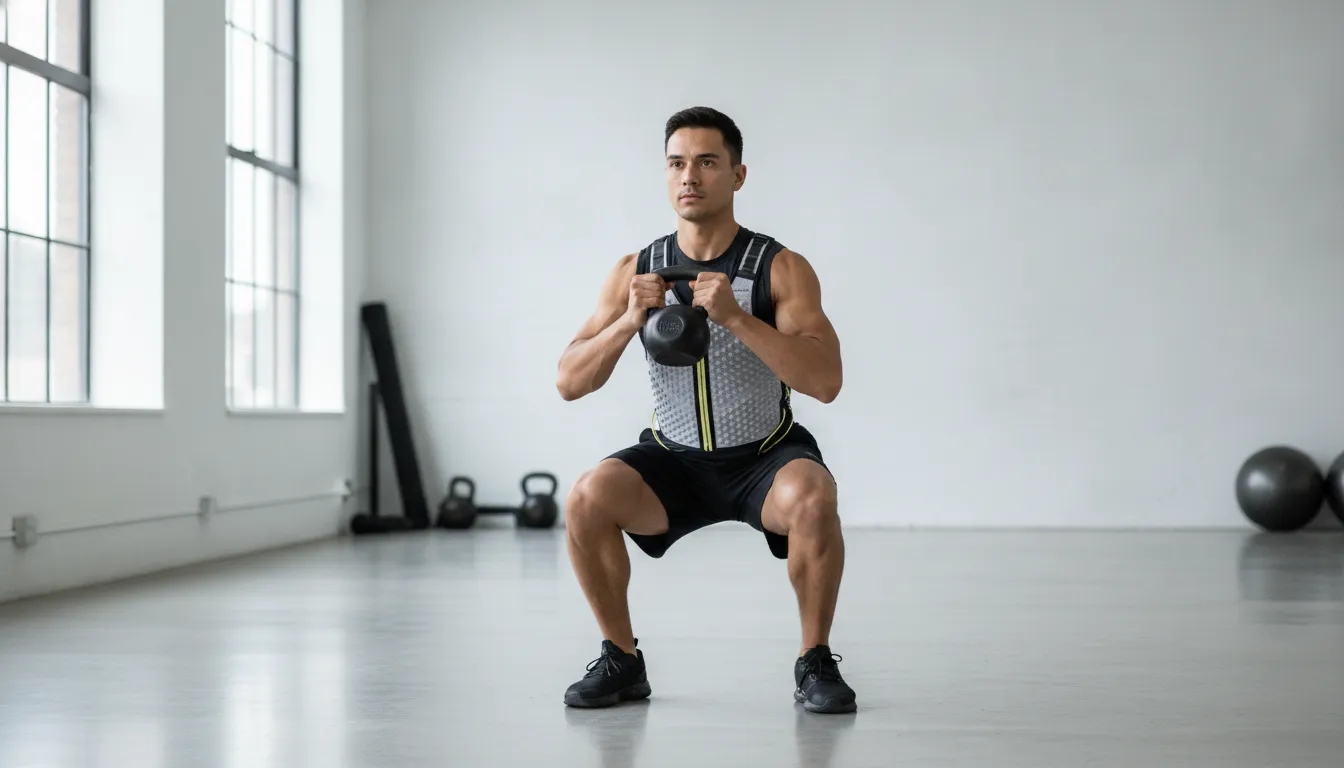
Training works best when the work resembles the result you want. A program for a faster run, stronger lift, or repeated-effort conditioning should not treat every exercise, pace, and progression as interchangeable.
The training specificity principle means that adaptations relate to the mode, frequency, and duration of exercise performed. Choose movements and training demands that reflect the goal. Then progress them while preserving that connection. Training closer to the desired outcome is predicted to improve it, although transfer is never unlimited (Hawley, 2008: PubMed).
That idea is more useful than simply labeling an exercise as effective or ineffective. The right question is whether it develops the qualities your goal actually requires. Start by defining the principle and how it shapes exercise selection.
Explore OMORPHO weighted gear for goal-specific training
What Is the Training Specificity Principle?
The training specificity principle states that the body adapts to the demands it repeatedly practices. In exercise science, this idea is often summarized by the acronym SAID: specific adaptation to imposed demands. The mode, frequency, and duration of exercise all influence the training response. A routine cannot be judged only by whether it feels difficult. Its relevance depends on how closely its demands match the outcome being pursued. Hawley's commentary in The Journal of Physiology discusses how training adaptations relate to the mode, frequency, and duration of exercise performed. Hawley, 2008.
Specificity also applies to which muscles and fibers are recruited. Training adaptations occur primarily in the muscle fibers recruited during the regimen, while untrained musculature may show little or no adaptive change. That does not mean every exercise must look exactly like a sport or test. It means the exercise should create a meaningful match with the physical demand that matters. Hawley, 2008.
Activity is not the same as outcome
"Getting fitter" describes a broad activity, not a defined result. A defined outcome might be completing a specific running distance, producing force in a particular movement, maintaining posture while fatigued, or repeating a task at a chosen speed. Each goal places different demands on movement pattern, muscle recruitment, force, velocity, coordination, and fatigue tolerance. The training plan becomes more specific when those demands are identified rather than treated as interchangeable.
This is why two routines can both qualify as exercise while preparing the body for different results. A general circuit may improve broad work capacity, but it does not automatically reproduce the speed, coordination, loading pattern, or duration required by a particular performance task. The principle of specificity predicts that the closer the training routine is to the requirements of the desired outcome, the better the likely transfer. Hawley, 2008.
How SAID guides practical choices
Start by naming the outcome in observable terms. Then ask which movement, muscles, energy demands, pace, and duration the outcome requires. Frequency matters as well because repeating a demand gives the body more exposure to that mode of work. These choices should remain connected to the goal, not selected simply because an exercise is popular or exhausting.
For a deeper look at how research informs wearable-resistance decisions, explore the science behind wearable resistance. The goal is not to make every session identical to the final task. It is to make the important parts of training purposeful enough that the adaptations being developed support the result being measured.
How Do You Match Training to a Goal?
Start with the outcome, then work backward. "Get fitter" is too broad to guide exercise selection. A useful goal names the performance or capacity to improve. Examples include running a faster 5K, producing force in a particular lift, sustaining repeated efforts, or moving through a larger range of motion. Hawley's review explains that a training routine closer to the desired outcome is expected to produce more specific transfer. Hawley, 2008.
Next, describe what the goal demands. Consider the movement pattern, the muscles and joints involved, the speed of movement, the external load, the range of motion, and the energy demand. The specificity principle also concerns the body parts, muscles, and physiological systems involved in a workout, as summarized by the University of Minnesota's physical activity text (University of Minnesota, Training Principles). A movement that looks similar may still create a different stimulus if its speed, resistance, duration, or fatigue level changes.
Then select the training variables that reproduce the important parts of the demand without trying to copy every detail at once. Volume describes how much work is performed, intensity how hard it is, and frequency how often sessions occur (Hawley, 2008). Duration matters when the goal depends on sustaining effort. Load and range of motion matter when force production or joint-specific control is central. These variables should support the goal rather than become isolated targets.
- Outcome: Define what should improve and how it will be observed.
- Movement: Match the relevant pattern, muscles, joints, range, and speed.
- Demand: Consider load, energy system, duration, volume, intensity, and frequency.
- Progression: Increase duration, time, or intensity step by step rather than changing everything together (University of Minnesota, Training Principles).
Specificity does not mean using one exercise forever. Training athletes generally involves developing broader capacities before emphasizing transfer to a performance measure. Stone and colleagues discuss this approach in their review of dynamic correspondence and the strength-endurance continuum (Stone et al., 2022). A strength-focused phase may prioritize a suitable load and controlled range, while an endurance goal may place greater emphasis on repeated work and duration. Review your volume and intensity choices as the goal changes.
Finally, account for recovery. Training impulses can improve fitness or reduce exercise capacity through fatigue, and chronic intensive training with inadequate recovery can impair performance (Hawley, 2008). The training specificity principle is therefore a process of matching the stimulus to the outcome, monitoring the response, and adjusting one variable at a time when possible.
Why Does Exercise Transfer Have Limits?
Transfer means that improvement in one exercise or training quality carries over to another task. That carryover can be useful, but it is rarely complete. A lift may build a capacity that supports sport performance without reproducing the timing, posture, perception, coordination, or fatigue pattern of the sport itself. The training specificity principle therefore works best as a matching tool, not as a promise that one movement automatically makes every related movement better.
Transfer limits come from the demands you actually practice
Specificity includes both the strength-endurance continuum and the principle of dynamic correspondence. The first matters because high-load, low-repetition work and high-volume, lower-load work represent different training emphases. They can overlap, but they do not create identical demands on the body. Research on specificity and dynamic correspondence describes these as distinct ends of a repetition and strength-endurance paradigm.
Dynamic correspondence adds another layer. A general lift might resemble a sport movement in broad shape while differing in the details that determine performance. Consider a loaded squat compared with changing direction on a field. Both may involve the lower body, but the sport task also includes a particular speed, balance strategy, direction, ground contact, decision, and sequence of muscle actions. Improving the squat can support general capacity. It does not, by itself, rehearse the complete skill or guarantee faster change of direction.
The same logic applies to running. Preparation for a shorter race can include sprint work and shorter runs. A marathon emphasizes a different duration and endurance demand. These examples illustrate why the desired outcome matters when selecting exercise. They do not prove that one type of training has no value outside its original setting. Complementary work can build useful capacity while sport practice develops the exact coordination and pacing required.
Ecological validity also limits what can be inferred from testing. Laboratory measures may be reliable while being less representative of the conditions in which an athlete performs. Field measures can better reflect the sport while introducing more variability. Researchers have described this tension directly. Sport-specific testing tools have also been developed to better match assessment procedures to sport demands.
For programming, the practical answer is not to abandon general exercises. Use them to develop relevant capacities, then include movements and intervals that resemble the target task. Define whether the priority is force, repeated effort, speed, skill, or a combination. Then align load, repetitions, rest, and movement conditions with that priority. A clear understanding of volume and intensity choices can help clarify which part of the continuum a session is emphasizing.
Specificity may improve the relevance of training, but balanced programming still matters. Focusing only on the exact task can leave gaps or increase repeated stress, while general work alone may not prepare the body for the sport's full demands. Transfer is strongest when capacity-building exercises and task-specific practice work together, with claims kept proportional to what was actually trained.
Applying Specificity to Strength, Running, and Hybrid Goals
The same equipment can support different sessions, but each session still needs a defined purpose. The training specificity principle is most useful when exercise selection, movement pattern, loading approach, and work duration resemble the outcome being developed. Research describes specificity as a closer match between training and the requirements of the desired task or performance criterion. Hawley, 2008
Strength goal
For a strength-focused goal, build the session around resistance exercises that train the muscles and movement patterns required. A practical example might center on squats, presses, rows, hinges, or carries, with choices adjusted for experience and the intended movement. High-load, low-repetition work and high-volume work represent different ends of the strength-endurance continuum, so they are not interchangeable stimuli. Stone et al., 2022
For short, intensive strength-conditioning work or slower movement emphasizing control, G‑Vest Icon may be a context-specific option. It should support a plan built around appropriate exercises and progression, not replace either. OMORPHO positions this vest for short intensive and slow core-stabilizing movement rather than long endurance running. OMORPHO product guidance See strength-focused exercise selection for related examples.
Running goal
A running plan should reflect the event or outcome. A 5K and a marathon place different emphasis on duration, distance, and the demands sustained across the effort. So preparation for one should not simply copy preparation for the other. Healthline's review of the specificity principle Sprint work and shorter training runs can support 5K preparation, while longer-duration work may be more relevant to an endurance goal. Healthline
If wearable resistance is included, G‑Vest Run is the relevant OMORPHO option for running and longer endurance work. G‑Wear can fit long-duration, repetitive movement when the goal is to add a small challenge across many strides. OMORPHO science guidance The product does not make a running plan specific by itself. Route, pace, duration, recovery, and movement quality still need to match the goal. See goal-specific running plans for examples.
Hybrid conditioning goal
Hybrid training combines demands rather than reducing them to one quality. A session may pair strength work with running, carries, intervals, or repeated transitions. The practical question is which demand should receive priority on a given day, and whether the order, volume, and intensity allow technique to remain consistent. Training responses depend on the mode, frequency, and duration performed, while additional stimulus can contribute to fatigue rather than useful adaptation. Hawley, 2008
G‑Vest Icon may suit a brief strength-conditioning block, while G‑Vest Run or G‑Wear may be more appropriate when the priority shifts to running or prolonged repetitive movement. These are examples, not a universal prescription. The choice follows the day's dominant demand and the athlete's current plan. Explore hybrid fitness training demands for a broader application.
How Should Progression and Recovery Fit?
Progression is not a universal instruction to add more weight, more distance, or more intensity every session. It is the gradual alignment of training demand with the outcome being pursued. If the goal is a specific movement, event, or performance quality. The next step should make that demand slightly more challenging while preserving the qualities that matter, such as controlled technique, useful speed, or repeatable effort.
The training specificity principle makes this distinction important. Training responses are closely tied to the mode, frequency, and duration of exercise performed, and adaptations are concentrated in the muscle fibers recruited during the regimen (Hawley, 2008). A progression that increases difficulty but changes the movement, pace, or energy demand too much may build general fitness without moving the intended performance forward.
Progress the demand, not just the number
Progression can involve a step-by-step increase in exercise duration, time, or intensity (University of Minnesota, Training Principles). The most useful variable depends on the goal. A runner may gradually extend the duration of a target-paced effort. Someone developing strength may increase resistance while keeping the movement pattern and execution consistent. A hybrid athlete may add repeated efforts or reduce rest only when doing so still resembles the demands of the event.
These are examples of decision-making, not universal prescriptions. There is no single load, percentage, weekly increase, or repetition range that fits every person and every goal. Real-world training does not always equate work in the same way as a controlled comparison, particularly when absolute loads and repetition counts differ (Stone et al., 2022). A practical progression should therefore respond to performance evidence: stable movement quality, appropriate effort, and the ability to complete the intended work without compensations.
For a deeper explanation of how gradual overload can be organized, see progressive overload in training.
Recovery is part of the stimulus
Every training impulse can contribute to fitness or fatigue. The balance depends on the size and timing of the stimulus, not simply on whether the session felt difficult (Hawley, 2008). More work is not automatically more productive. A threshold may exist beyond which additional exercise does not create further increases in functional capacity. Chronic intensive training combined with inadequate recovery can reduce performance and contribute to overtraining syndrome (Hawley, 2008).
Monitor whether the intended demand is still visible in the session. If fatigue changes technique, slows the required movement, reduces control, or makes the target effort inconsistent, hold the progression steady or reduce the session demand. Recovery days, easier sessions, and variation can preserve training quality while allowing the next specific stimulus to be productive. Equipment can support that plan, but it should illustrate an outcome-specific progression rather than replace thoughtful exercise selection and recovery planning (OMORPHO, Fitness).
Can Wearable Resistance Support Specificity?
Wearable resistance can support the training specificity principle when it is chosen for a defined movement demand. It should not replace goal-led programming. The starting point remains the outcome: running longer, preparing for a short high-intensity effort, improving control during slow movement, or adding a manageable challenge to repeated activity.
Specificity means that training responses are closely related to the mode, frequency, and duration of the exercise performed. Adaptations also occur primarily in the muscle fibers recruited during training. And a routine that more closely resembles the desired task is expected to produce a more relevant outcome. Hawley explains these elements of specificity in exercise physiology. That does not mean every session must copy competition or daily life exactly. It means the equipment, movement, pace, duration, and progression should make sense for the demand being practiced.
Match the product to the movement demand
For running and longer endurance work, G‑Vest Run is the more relevant G‑Vest option. Its use can be considered within a running plan where the athlete can maintain sound mechanics and the added resistance fits the session goal. G‑Vest Icon is positioned for short intensive workouts and slow movement work, where the training demand differs from longer, continuous running. It is not the running recommendation.
G‑Wear serves a different purpose. It distributes small amounts of resistance through apparel and is intended for long-duration, highly repetitive movement. That makes it a context-specific option for adding a subtle challenge across repeated actions, rather than a universal substitute for strength, speed, or endurance programming.
These products use MicroLoad™ as a design philosophy for distributing resistance, not as one material. G‑Vests use stainless steel ball bearings held between durable fabric layers. G‑Wear uses high-density polymer print fused to the fabric. Understanding that distinction helps keep product selection tied to the movement and the intended training effect. The science behind wearable resistance provides additional context.
A useful check is simple: does the wearable support the movement quality and duration the session requires? If it changes the task so much that technique, pacing, or recovery no longer match the goal, the equipment is no longer serving specificity. Used thoughtfully, it can complement a plan. It cannot decide the plan.
Find weighted gear for your movement goal
Frequently Asked Questions
What is the training specificity principle in simple terms?
The training specificity principle means that adaptations reflect the mode, frequency, and duration of the exercise performed. Training tends to be more useful for a goal when its movements, muscles, intensity, and energy demands resemble that goal. Hawley, 2008 explains that responses are closely coupled to the exercise conditions.
How do you apply specificity when choosing exercises?
Start with the outcome, then identify the actions and capacities it requires. A strength goal may emphasize force production with appropriately loaded resistance, while an endurance goal may require sustained work at a relevant pace and duration. Match exercise selection to the goal without assuming that one movement can reproduce every sport or activity demand.
Does specificity mean every workout must copy the target activity?
No. General exercises can build foundational strength, conditioning, or movement capacity before more closely matched work is added. Specificity predicts better transfer when training resembles the desired task, but broader preparation can help develop the capacities needed for that task. Stone et al., 2022 describe capacity development as an important part of optimizing transfer.
How should progression fit into a specific training plan?
Progression means increasing training demand step by step through variables such as duration, time, or intensity. Change the variable that best matches the goal, while monitoring movement quality, performance, and fatigue. More training is not always better: a threshold may exist beyond which additional exercise no longer improves functional capacity, and inadequate recovery can reduce performance. University of Minnesota, Training Principles supports gradual progression and overload.
Ready to Match Resistance to Your Goal?
Training becomes more purposeful when the exercise, resistance, and progression reflect the outcome you want to improve. Explore OMORPHO weighted gear to choose a resistance option that fits the movement goal, whether the focus is controlled strength work, conditioning, or another specific demand.