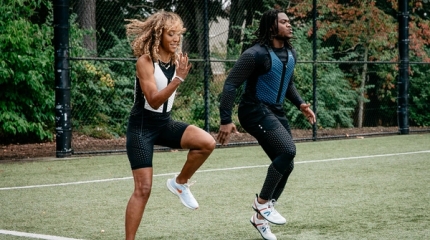
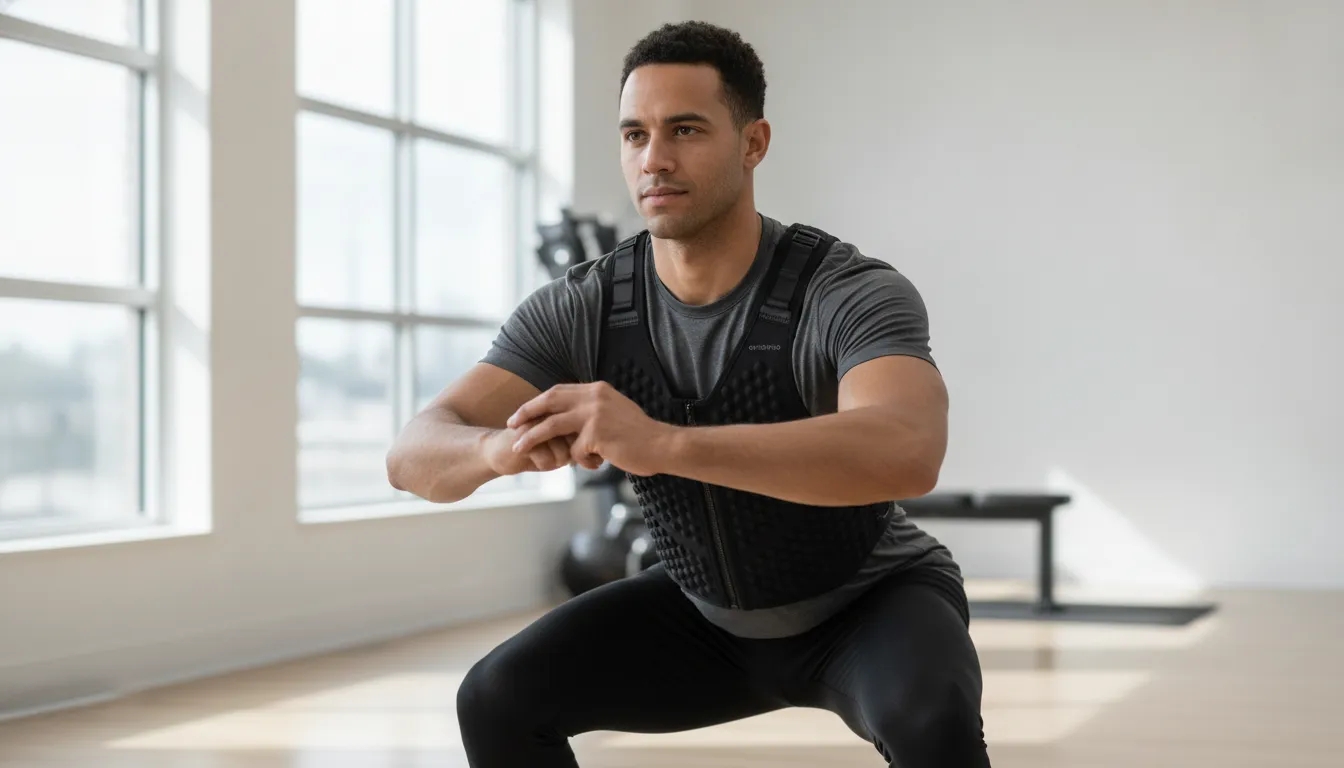
Key Takeaways
- Choose Based on Your Goals: Select calisthenics for building functional, real-world strength and improving body control, or opt for traditional weight lifting if your main objective is gaining maximum muscle size and raw power.
- Combine Methods for Well-Rounded Fitness: A hybrid routine offers the best of both worlds, using weight lifting to build a strong foundation and calisthenics to enhance mobility and endurance, creating a more capable and resilient body.
- Add Resistance Intelligently: Apply progressive overload to bodyweight exercises safely with OMORPHO gear. The MicroLoad™ design in G‑Vest products adds a distributed challenge that helps you get stronger without compromising your form or joint health.
Weighted Calisthenics vs. Weight Lifting: What's the Difference?
At a glance, weighted calisthenics and traditional weight lifting seem to chase the same goal: getting stronger by adding resistance. While both paths can lead to impressive results, they take different routes to get there. The fundamental difference lies in the source of resistance. Calisthenics uses your body as the primary weight, while weight lifting relies on external objects like dumbbells and barbells.
Understanding how each method works is the first step in deciding which one, or which combination, is right for you. One focuses on mastering movement with your own body, and the other focuses on moving a fixed external load. This distinction affects everything from the muscles you build to the type of strength you develop. Before you can choose the best training style for your goals, let's break down what defines each practice and how they apply resistance to your body.
What is Weighted Calisthenics?
Calisthenics is a form of strength training that uses your own body weight as resistance. Think of foundational exercises like push-ups, pull-ups, squats, and lunges. These movements build functional strength, endurance, and flexibility with minimal equipment. Weighted calisthenics takes this a step further by adding external weight to these bodyweight exercises. This is an effective way to keep challenging your muscles once standard bodyweight movements become too easy.
Adding a weighted vest to your pull-ups or wearing weighted apparel during squats increases the intensity, forcing your muscles to adapt and grow stronger. This method allows you to apply progressive overload to movements you've already mastered. High-quality gear like OMORPHO's G‑Vest products are designed for this purpose, providing a safe and effective way to add resistance without compromising your form.
What is Traditional Weight Lifting?
Traditional weight lifting uses external weights, such as dumbbells, barbells, kettlebells, and weight machines, to create resistance. This training style is exceptionally effective for building muscle because it makes progressive overload straightforward. To make a workout harder, you simply add more weight to the bar or pick up a heavier dumbbell.
This method is ideal for isolating specific muscle groups, like doing bicep curls or leg extensions. Because you can incrementally increase the load, weight training is a very direct path to gaining maximum muscle mass and strength. The focus is less on complex body movement and more on moving a specific amount of weight for a set number of repetitions.
Comparing Load Types: Fixed vs. Distributed
Your muscles grow in response to a challenge, whether that challenge comes from a barbell or your body plus added weight. However, the way that weight is loaded onto your body matters. Traditional weights like dumbbells or plates on a barbell represent a fixed, concentrated load. All the resistance is focused on a single point that you have to lift and control.
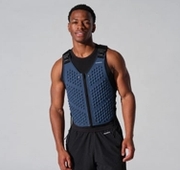
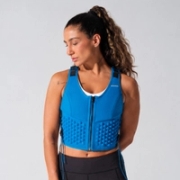
In contrast, OMORPHO's MicroLoad™ weighted gear introduces a distributed load. The OMORPHO G‑Vest Icon, for example, uses small stainless steel ball bearings evenly spread throughout the vest. This design hugs your core and integrates the weight with your body, making it feel more natural and less noticeable. This ergonomic approach allows for greater freedom of movement and places less stress on your joints compared to the concentrated load of traditional weights.
How Each Method Builds Muscle and Strength
Both weight lifting and calisthenics rely on the principle of progressive overload to build strength. This simply means you must consistently challenge your muscles to do more than they are used to. When your body adapts to a certain level of stress, you need to increase the demand to keep making progress. However, the way you apply this principle differs significantly between the two training styles, leading to different types of strength gains. Understanding these differences is key to choosing the right path for your fitness journey.
Applying Progressive Overload with Weights
With traditional weight lifting, applying progressive overload is very direct. To make a workout harder, you simply add more weight to the barbell, grab a heavier dumbbell, or adjust the pin on a machine. This method makes it easy to measure your progress and systematically increase the load. Weight training is also excellent for isolating specific muscle groups. If you want to build your biceps, you can do bicep curls. If you want stronger quads, you can focus on leg extensions. This targeted approach is highly effective for building maximum muscle size and strength in a particular area of the body.
Applying Progressive Overload with Bodyweight
Progressive overload in calisthenics is more about skill and leverage than just adding plates. You make exercises harder by changing your body's position to increase the resistance. For example, you might progress from a kneeling push-up to a standard push-up, and then to a decline push-up. Another powerful way to apply progressive overload is by adding weight to your body. This is where weighted calisthenics comes in. Wearing a high-quality, low-profile vest like the OMORPHO G‑Vest Icon allows you to increase the challenge of every movement without altering your form, blending the convenience of weight training with the functional benefits of calisthenics.
Building Functional Strength and Body Control
Calisthenics excels at developing functional strength, which is the strength you use in everyday life. Because you're moving your entire body through space, you engage multiple muscle groups at once, including the small stabilizer muscles that are crucial for balance and coordination. This builds incredible body control and core stability. Adding OMORPHO's MicroLoad™ weighted gear enhances this effect. The strategically distributed weight challenges your body's natural movement patterns, helping you build strength that translates directly into better posture, improved agility, and more power in everything you do, both in and out of the gym.
The Pros and Cons of Each Training Style
Choosing between weighted calisthenics and traditional weight lifting depends entirely on your personal fitness goals, preferences, and what you have access to. Both are powerful methods for building strength, but they achieve it in different ways. One focuses on mastering your own bodyweight with added resistance, while the other centers on lifting external loads. Understanding the advantages and disadvantages of each will help you decide which path, or combination of paths, is the right fit for you.
Pros and Cons of Weighted Calisthenics
Weighted calisthenics is excellent for developing functional strength that directly supports your daily activities. By adding weight to foundational movements like pull-ups, push-ups, and squats, you enhance muscle tone, balance, and full-body coordination. This training style teaches your muscles to work together as a single, stable unit. The main challenge, however, is applying progressive overload. It can be difficult to consistently make exercises harder, especially for the lower body or smaller muscle groups. This is where adding a safe, wearable load becomes a game-changer for continuous progress.
OMORPHO gear makes it easy to add that challenge. Instead of awkwardly holding a dumbbell, you can wear a G‑Vest Icon to integrate a distributed load that moves naturally with your body.
Pros and Cons of Weight Lifting
Traditional weight lifting is the classic method for building significant muscle size and raw strength. Its biggest advantage is straightforward progressive overload; to make a workout harder, you just add more weight. This makes it incredibly effective for isolating specific muscles and visibly tracking your gains. On the other hand, weight lifting carries a higher risk of injury, especially from poor form or lifting too heavy. It also requires access to specialized equipment like barbells, dumbbells, and machines, which can be a barrier for some people. While great for building strength, the concentrated load of heavy weights can put significant stress on your joints.
Comparing Injury Risk, Joint Health, and Accessibility
Calisthenics is often seen as a safer starting point because it's based on natural movement patterns that can improve joint health and bone density. Weight lifting requires a strict focus on proper form to keep your joints safe from injury. In terms of accessibility, calisthenics wins for convenience since you can do it almost anywhere with minimal equipment. Weight lifting is dependent on having access to a gym or a well-stocked home setup.
OMORPHO bridges the gap, giving you the benefits of added resistance without the common drawbacks. The MicroLoad™ design in our G‑Vest and G‑Wear collections spreads weight evenly across your body. This unique approach challenges your muscles safely, without overloading your joints, making every workout more efficient and supporting your long-term health.
Which Training Method Is Right for Your Goals?
Deciding between weighted calisthenics and traditional weight lifting isn't about finding a single "best" method. Instead, the right choice depends entirely on what you want to achieve. Each style of training offers a unique set of benefits, and understanding them helps you create a plan that aligns perfectly with your personal fitness objectives. Weight lifting excels at building raw strength and muscle size through targeted, heavy loads. Calisthenics, on the other hand, develops functional strength and body control by training your muscles to work together in complex movement patterns.
Your training doesn't have to be an either-or decision. Many people find that a hybrid approach gives them the most well-rounded results. You might focus on weight lifting for a few months to build a solid foundation of strength, then switch to calisthenics to improve your mobility and endurance. The key is to stay adaptable and listen to your body. As your goals evolve, your training can too. By exploring both methods, you can discover what makes you feel strongest and most capable in your daily life and athletic pursuits. This allows you to build a sustainable routine that supports your long-term fitness journey.
For Building Maximum Muscle Mass
If your primary goal is to build as much muscle as possible, traditional weight lifting generally has the advantage. The reason is simple: progressive overload is incredibly straightforward. To challenge your muscles and stimulate growth, you just add more weight to the bar or pick up heavier dumbbells. This method also makes it easy to isolate specific muscle groups, like your biceps or quads, allowing you to focus your efforts for targeted development.
However, that doesn't mean you can't build significant muscle with weighted calisthenics. By adding external resistance, you can turn bodyweight exercises into powerful muscle-builders. For example, wearing a weighted vest like the G‑Vest Icon during pull-ups or dips dramatically increases the demand on your muscles, pushing them to adapt and grow stronger.
For Functional Strength and Mobility
When it comes to building strength that translates directly into everyday life, calisthenics is a clear winner. These exercises train your body to move as a cohesive unit, improving coordination, balance, and flexibility. Think about movements like squats, lunges, and push-ups; they mimic actions you perform daily, like lifting groceries or getting up from the floor. This focus on compound movements engages major muscle groups and the smaller stabilizing muscles that are often overlooked in isolated weight lifting exercises.
This integrated approach is essential for developing true functional fitness. By mastering control over your own bodyweight, you build a foundation of strength that supports every activity you do. It also enhances your core stability, which is crucial for maintaining good posture and preventing injury.
For Fat Loss and Calorie Burn
Calisthenics is an excellent tool for fat loss, primarily because it keeps you moving. Workouts are often structured as circuits or high-intensity interval training (HIIT), minimizing rest time and keeping your heart rate elevated. Dynamic, full-body exercises like burpees, mountain climbers, and jumping jacks are incredibly effective at burning calories during your session. This high-energy output makes calisthenics a very efficient way to create the calorie deficit needed for fat loss.
While weight lifting also burns calories, the longer rest periods between heavy sets can lower the overall metabolic demand of the workout. To make your sessions even more effective, you can add light, distributed resistance. Wearing G‑Wear apparel during a calisthenics circuit adds a subtle challenge that increases calorie burn without disrupting your form or slowing you down.
For Athletic Performance and Longevity
For athletes and anyone focused on long-term health, a hybrid approach that combines weight lifting and calisthenics is often the ideal solution. This strategy allows you to get the best of both worlds: the raw power and strength from lifting heavy weights, plus the mobility, body control, and endurance from calisthenics. This combination creates a resilient, well-rounded athlete who is less prone to injury.
You can further enhance this approach by incorporating MicroLoad™ weighted gear into your training. Adding a small amount of distributed weight with OMORPHO products challenges your body in a way that improves your natural movement patterns. This helps you get stronger and more powerful without compromising your form or joint health, directly supporting your athletic performance and promoting a lifetime of activity.
The Hybrid Approach: Getting the Best of Both Worlds
You don't have to choose between bodyweight exercises and lifting weights. In fact, combining both training styles into a hybrid routine can help you achieve well-rounded fitness, building strength, endurance, and mobility all at once. This approach keeps your workouts interesting and challenges your body in new ways, preventing plateaus and reducing the risk of overuse injuries.
A hybrid plan allows you to use the right tool for the right job. You can use traditional weights for targeted muscle growth and maximum strength development, then use calisthenics to improve your body control, core stability, and functional movement patterns. This balanced method is effective for almost any fitness goal, from athletic performance to long-term health and longevity. The key is to structure your workouts in a way that leverages the unique benefits of each discipline.
How to Combine Weight Lifting and Calisthenics
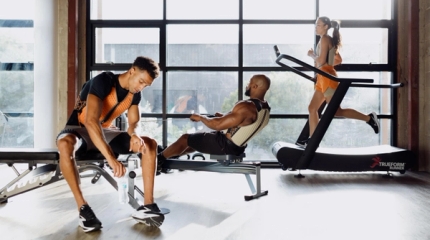
Integrating calisthenics and weight lifting is straightforward. You can dedicate specific days to each discipline, for example, with two weightlifting days and two calisthenics days per week. Another popular method is to incorporate bodyweight exercises into your lifting sessions, such as adding pull-ups on back day or dips on chest day. For an added challenge, you can wear a weighted vest during your calisthenics movements. The OMORPHO G‑Vest Icon adds a significant load to exercises like push-ups and squats, effectively bridging the gap between bodyweight training and weight lifting. This MicroLoad™ weighted gear is designed to move with you, providing a safe and comfortable challenge without compromising your form.
Which Goals Benefit Most from a Hybrid Plan?
A hybrid plan is incredibly versatile and supports a wide range of fitness ambitions. If your goal is building functional strength that translates to everyday life and athletic activities, this approach is ideal. The combination helps you develop raw power from lifting and the coordination to apply it from calisthenics. For general fitness and longevity, a hybrid routine provides the perfect mix of muscle-building stimulus and joint-friendly movement. Ultimately, the best workout plan is one you enjoy and can stick with consistently. By combining weights and calisthenics, you create a sustainable and effective routine that helps you build a capable, resilient body for any performance goal.
Don't Let These Myths Hold You Back
When deciding between weighted calisthenics and traditional weight lifting, it's easy to get caught up in common misconceptions. These training styles are often pitted against each other, but the truth is more nuanced. Understanding the facts can help you choose the right path for your fitness journey, or even combine them for better results. Let's clear up a few myths that might be holding you back from exploring the full potential of bodyweight training.
Myth: "Calisthenics can't build serious muscle."
This is one of the most persistent myths out there. The reality is that your muscles grow in response to resistance, regardless of the source. You can absolutely build muscle with calisthenics because your body weight provides significant resistance to work against. Think about the strength required for pull-ups, dips, and pistol squats. As you get stronger, you can move on to more difficult exercise variations to keep challenging your muscles. For those looking to intensify their training, adding MicroLoad™ weighted gear like a G‑Vest Icon makes it possible to add external load to these movements, further stimulating muscle growth and strength adaptation.
Myth: "You need a barbell for progressive overload."
Progressive overload is the key to getting stronger, and it simply means you need to make your exercises harder over time. With weight lifting, this is straightforward: you add more weight to the bar. But that's not the only way. In calisthenics, you can apply progressive overload by changing the exercise itself, like moving from a standard push-up to an archer push-up. Another powerful method is to add weight directly to your body. Wearing a G‑Vest Icon during your routine increases the resistance without changing your form, allowing you to progressively overload foundational movements and continue making gains in strength and stability.
Myth: "Weight lifting is always better for strength."
While weight training may have a slight edge for developing maximal strength quickly, it's not the only path to getting stronger. Calisthenics excels at building functional strength, which is the strength you use in everyday life and sports. It improves your body control, balance, and core stability in a way that isolated weight lifting movements often don't. True strength isn't just about how much you can lift; it's also about how well you can move and control your own body. By focusing on compound movements, calisthenics develops a well-rounded, athletic strength that translates directly into better performance and a reduced risk of injury.
Myth: "Calisthenics is just for beginners."
It's true that calisthenics can be less intimidating for beginners, but it's far from a beginner-only discipline. The skill ceiling for calisthenics is incredibly high, with advanced movements like the human flag, planche, and one-arm pull-up requiring immense strength and control that can take years to master. The beauty of calisthenics is its scalability. A complete novice can start with knee push-ups, while an elite athlete can work on explosive muscle-ups. Adding OMORPHO MicroLoad™ weighted gear further expands this range, making even the most basic exercises a challenge for seasoned fitness enthusiasts and proving that bodyweight training is a lifelong practice.
Bridge the Gap with OMORPHO MicroLoad™ Gear
When bodyweight exercises start to feel too easy, adding resistance is the key to keep making progress. As research shows, weighted calisthenics is highly effective for building muscle once you've mastered the basics. This is where you can bridge the gap between bodyweight training and traditional weight lifting. Instead of reaching for a barbell, you can integrate small, distributed loads into your movements with OMORPHO's innovative MicroLoad™ weighted gear. This approach makes it simple to add a challenge to your favorite fitness routines without changing your form or sacrificing mobility.
The entire OMORPHO collection is built on the principle of MicroLoad™ technology, which strategically places small amounts of weight across the body. This design helps you get stronger by adapting to the added load, improving your endurance, and enhancing your core stability. It's a smart and efficient way to apply progressive overload to your calisthenics practice. By adding just a little weight, you make every movement more effective, helping you burn more calories and build functional strength without needing a room full of equipment.
Amplify Your Training with the G‑Vest Icon and G‑Vest Run
OMORPHO G‑Vest products are designed to integrate perfectly into your bodyweight training. Your muscles respond to the challenge, not the source of the weight, which means adding a G‑Vest can be just as effective as using external weights. For maximal strength development in exercises like pull-ups and dips, the G‑Vest Icon is an ideal choice. It starts at 10 pounds (4.5 kg) for men and 6 pounds (2.7 kg) for women and is adjustable for a greater challenge. For more dynamic circuits or agility work, the lighter G‑Vest Run offers a moderate load that won't disrupt your movement. Both are the safest, highest quality options, featuring a low-profile, body-hugging fit with evenly distributed stainless steel ball bearings that reduce the risk of injury.
Layer on G‑Wear Apparel for a Full-Body Challenge
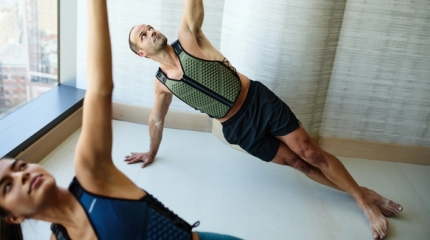
Calisthenics is an accessible workout method because it primarily uses your own body weight. OMORPHO G‑Wear apparel enhances this accessibility by embedding weight directly into your clothes. Using a high-density polymer print fused to flexible fabric, G‑Wear products like the G‑Top Short Sleeve and G‑Tight add a subtle, full-body challenge that you'll barely notice. This makes them perfect for high-repetition exercises or workouts that require a wide range of motion, like yoga and pilates. For an even greater challenge, you can layer G‑Wear apparel under a G‑Vest, creating a comprehensive MicroLoad™ system that distributes weight from your shoulders to your legs for a powerful, full-body training session.
Frequently Asked Questions
I'm new to weighted training. Is it better to start with a weighted vest or traditional weights? Starting with weighted calisthenics using a high-quality vest is often a great entry point. It allows you to add resistance to movements your body already knows, like squats and push-ups, which helps build foundational strength and body control safely. Traditional weight lifting is also effective, but it requires a stronger focus on learning proper form to prevent injury. A vest integrates the weight with your body, making the transition into resistance training feel more natural.
Can I build as much muscle with weighted calisthenics as I can with weight lifting? While traditional weight lifting is exceptionally effective for building maximum muscle size due to its straightforward approach to progressive overload, weighted calisthenics is fantastic for developing a strong, lean, and athletic physique. It builds incredible functional strength by forcing your muscles to work together. Your muscles grow in response to challenge, and adding a G‑Vest Icon to your bodyweight routine provides a significant challenge that will absolutely lead to muscle growth.
Which OMORPHO vest should I choose for my calisthenics routine, the G‑Vest Icon or the G‑Vest Run? Your choice depends on your goals. The G‑Vest Icon is your best option for building maximum strength with exercises like weighted pull-ups, dips, and squats. It starts at a heavier weight, 10 pounds (4.5 kg) for men and 6 pounds (2.7 kg) for women, and is designed for intense sessions. The G‑Vest Run is lighter and ideal for more dynamic circuits, agility drills, or for anyone who is just beginning to explore weighted training and wants a more moderate challenge.
How is wearing a G‑Vest different from just holding a dumbbell during a squat? The difference is in how the weight is loaded onto your body. Holding a dumbbell creates a concentrated load that you must actively balance, which can sometimes compromise your form. OMORPHO G‑Vest products use a MicroLoad™ distributed weight design, spreading the resistance evenly across your core. This makes the weight feel like a part of you, allowing for more natural movement and placing less stress on your joints while still challenging your muscles.
Can I wear OMORPHO gear for my entire hybrid workout, including the weight lifting parts? Absolutely. G‑Wear apparel, like the G‑Top Short Sleeve or G‑Tight, can be worn during any workout to add a subtle, constant challenge that increases your calorie burn and muscle engagement. You can also wear a G‑Vest during your warm-up or as a finisher on lifting days. For example, performing bodyweight exercises with a vest after your main lifts is a great way to build endurance and ensure you've fully challenged your muscles.